Same ecosystem. Greater reach.

Mid-360 has been superseded by Mid-360S and is no longer available to order. This page is kept as a technical reference for existing deployments.
See Mid-360SMid-360 is the previous generation of Livox’s compact 360° sensor, succeeded by Mid-360S. It shares the same hybrid rotating-mirror scan pattern, 360°×59° field of view, mounting interface and SDK as its successor. Mid-360S refines the range envelope and close-in precision; the figures below are the manufacturer’s specification for the original Mid-360.
 Front view
 Mounting kit included
Mid-360 uses the same hybrid rotating-mirror technology as its successor Mid-360S, delivering a horizontal field of view of 360° and a vertical field of view of 59°. The omnidirectional scene coverage lets a mobile robot perceive its surroundings from every direction — the basis for route planning and decision-making.
Mid-360 keeps the compact proportions of the Mid-360 family, but its housing and optical assembly have been reinforced for outdoor work — in variable lighting, humidity and the dust of construction sites or farmland.
Mid-360 detects targets with 10% reflectivity up to 40 m away, and up to 70 m against highly reflective (80%) surfaces. Active anti-interference and light-independent operation are shared with its successor Mid-360S.
Detection range at 10% target reflectivity
Resistance to interference from other LiDAR sensors nearby
Detection range at 80% target reflectivity
Angular resolution improves as integration time increases:

0.1 s integration
0.5 s integration

2 s integration
As with Mid-360S, Mid-360 delivers advanced 3D perception compared with 2D single-line LiDAR sensors, giving mobile robots enough environmental data for mapping and positioning without modifying the surrounding space. The angular resolution of Mid-360 also improves significantly with integration time, boosting small-object detection to keep operation safe.
Mid-360 is not affected by ambient light, indoors or outdoors. Its point cloud data helps mobile robots with navigation, obstacle avoidance and detection classification — the same AI-ready foundation carried forward into Mid-360S.
Mid-360 replaces a set of several 2D sensors with a single compact 3D module — it earns its place wherever weight, size and full scene coverage matter.
Mounted on multirotor platforms such as DJI Matrice 400, Mid-360 gives the aircraft real-time 3D awareness for terrain-following, making inspection flights safer.
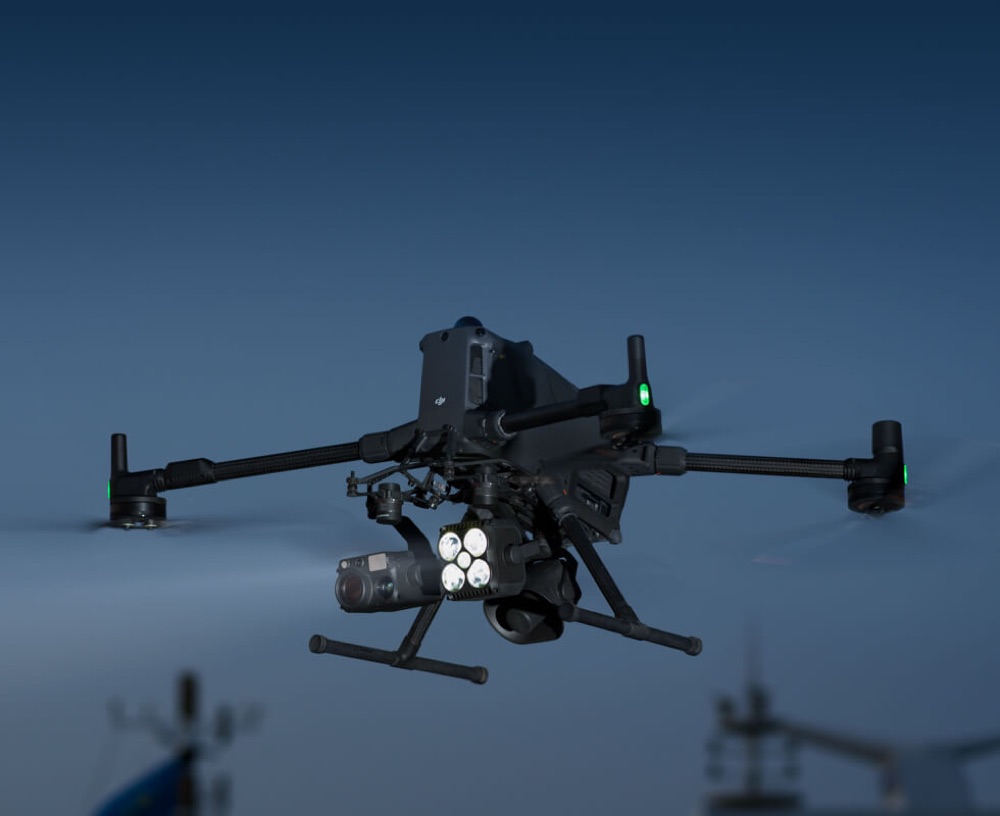
Real-time LiDAR point cloud visualization gives clearer, more intuitive obstacle detection than FPV alone. That matters most with small obstacles or night operations, giving agricultural drone operators better situational awareness and safety.

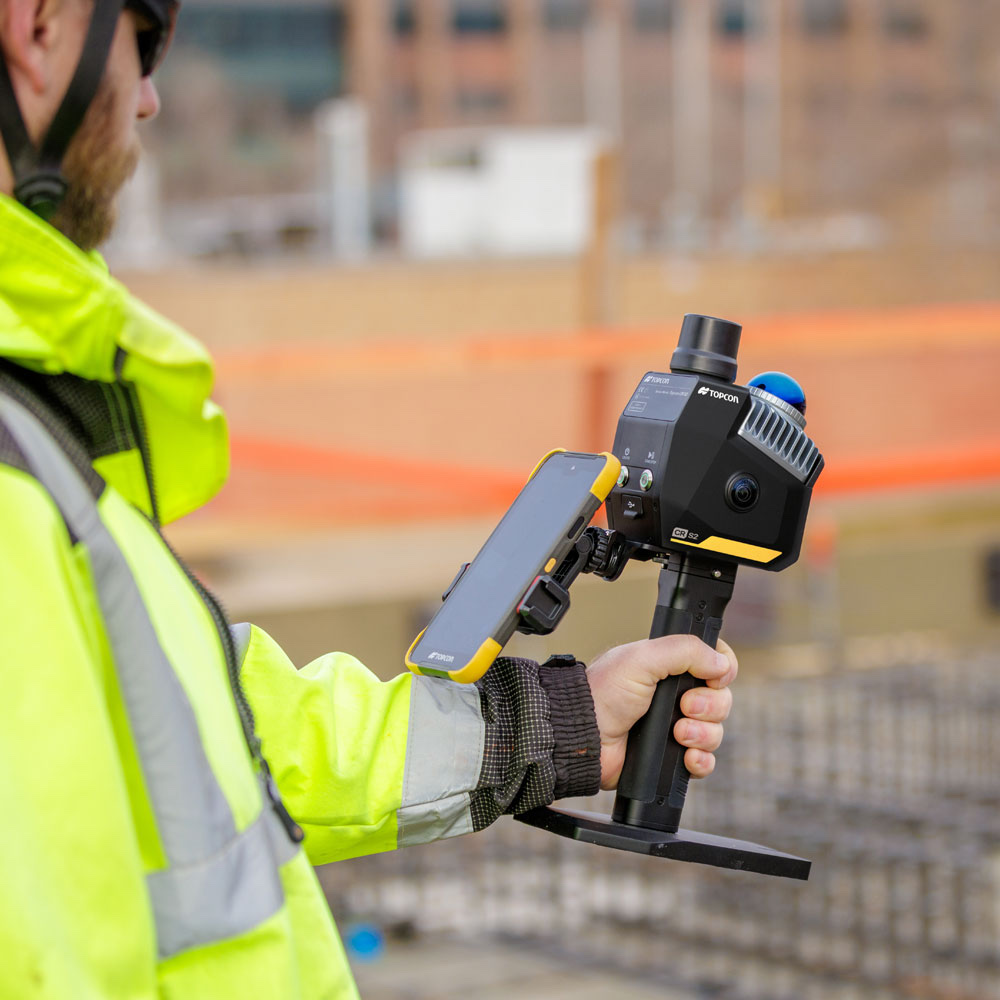
Handheld systems — such as the Topcon CR-S2 — are one of the fastest-growing uses for sensors like the Livox Mid-360, pairing real-time SLAM positioning with dense, colorized point-cloud capture. Devices in this class share characteristic specs: up to 200,000 points per second and range up to 70 m at 80–90% reflectivity, with accuracy around 2 cm and single-operator use. Full horizontal coverage means the operator doesn't have to aim the head — they simply walk normally, and the point cloud builds up around them, vertically too: floor, walls and ceiling captured in one pass.
Typical applications include as-built documentation and scan-to-BIM, construction progress monitoring, underground space inventory, stockpile volume measurement, and rapid incident documentation. It's worth noting that mobile scanning carries trajectory drift — where single-point survey-grade accuracy is required, a static scanner or total station remains the right tool.
Mounted on AGV forklifts, Mid-360 delivers full 360° coverage around the vehicle, eliminating blind spots during loading and unloading in narrow warehouse aisles.
An IP67 housing at 265 g allows mounting on the cabin roof or a mast without modifying the load-bearing structure, while a built-in IMU and the Livox ROS Driver 2 shorten the path from prototype to production deployment.
The sensor handles perception and navigation — in applications subject to machine-safety requirements, it works alongside a certified safety scanner, not as a replacement for one.
In autonomous mobile robots (AMRs) and in legged robots such as Unitree, the Mid-360 LiDAR head delivers dense 3D data for mapping and navigation, replacing a set of several 2D sensors with a single compact module mounted on top of the platform.
Full horizontal coverage eliminates blind spots around the robot, so the same sensor handles localization, obstacle detection and docking — without adding directional sensors and without cross-calibrating several devices at different mounting heights. The tall vertical field of view matters especially on quadruped platforms: with every step the robot’s body rocks in pitch and roll, and a planar LiDAR loses its reference to the surroundings. The Mid-360 keeps both the floor and overhead structures continuously in view, which makes it possible to guide the robot over stairs, gratings and uneven technical terrain.

In inspection robots, Livox Mid-360 removes the usual split between a “sensor for driving” and a “sensor for measuring”. The same head guides the platform around the site and, at the same time, records the point cloud that becomes documentation of the installation’s condition. For an integrator that means less hardware on board, a single data stream to synchronize and a lower unit cost per robot.
A 360° × 59° field of view covers everything around the platform with no blind spots — no array of directional sensors, no rotating head. With a built-in IMU, an IP67 rating, 265 g and 65 × 65 × 60 mm, it fits even on a small platform.


Both share the same 360° platform — full spec-by-spec comparison below.
 Mid-360SCompare specs |  Mid-360You’re here | |
|---|---|---|
| Range (@100 klx) | 40 m @10% 100 m (cut-off) | 40 m @10% 70 m @80% |
| False alarm rate (@100 klx) | < 0.01% | < 0.01% |
| Range precision | ≤ 2 cm (@10 m) ≤ 4 cm (@0.2 m) | ≤ 2 cm (@10 m) ≤ 3 cm (@0.2 m) |
| Angular random precision (1σ) | < 0.15° | < 0.15° |
| Horizontal FOV | 360° | 360° |
| Vertical FOV | −7°…52° | −7°…52° |
| Beam divergence | 0.1° × 1° | 0.1° × 1° |
| Data rate | 200,000 pts/s (first return) | 200,000 pts/s (first return) |
| Supply voltage | 9–27 V DC | 9–27 V DC |
| Power | Rated ≤ 6.5 W Startup ≤ 18 W | Rated ≤ 6.5 W Startup ≤ 18 W |
| Dimensions (L×W×H) | 65 × 65 × 60 mm | 65 × 65 × 60 mm |
| Weight | 265 g | 265 g |
| Operating temperature | −20 °C…55 °C | −20 °C…55 °C |
| Time synchronization | IEEE 1588-2008 (PTPv2) GPS (UTC + PPS) | IEEE 1588-2008 (PTPv2) GPS (UTC + PPS) |
| Data interface | 100 Mbps Ethernet | 100 Mbps Ethernet |
| Laser wavelength & safety class | 905 nm · Class 1 | 905 nm · Class 1 |
| Ingress protection | IP67 | IP67 |
Source: official Livox specification sheet.
| Model | Mid-360 |
|---|---|
| Recommended scenarios | AGV/AMR, commercial mobile robots, robotic mowers |
| Detection range (@100 klx) | 40 m @10% reflectivity · 70 m @80% reflectivity |
| False alarm rate (@100 klx) | < 0.01% |
| Range precision | ≤ 2 cm (@10 m) · ≤ 3 cm (@0.2 m) |
| Angular random precision (1σ) | < 0.15° |
| Field of view (FOV) | Horizontal 360° · Vertical −7°…52° |
| Beam divergence | 0.1° × 1° (typical) |
| Point rate | 200,000 pts/s (first return) |
| Supply voltage | 9–27 V DC |
| Power | Rated ≤ 6.5 W · Startup ≤ 18 W |
| Dimensions (L×W×H) | 65 × 65 × 60 mm |
| Weight | 265 g |
| Operating temperature | −20 °C to 55 °C |
| Time synchronization | IEEE 1588-2008 (PTPv2) · GPS (UTC time + PPS pulse) |
| Data interface | 100 Mbps Ethernet |
| Laser wavelength & safety class | 905 nm · Class 1 eye-safe |
| Ingress protection | IP67 |
All figures above are taken from the official Livox specification sheet.
Mid-360 shares its platform and connector layout with the Mid-360S — the official Livox documentation below covers installation and mounting for both.
Mid-360S is the newer revision and the one currently available. Both share the same 360°×59° field of view, 200,000 pts/s point rate, 65×65×60 mm housing and 265 g weight. Mid-360S is specified with a 100 m cut-off range, while Mid-360 is rated 70 m @80% reflectivity; close-in precision differs slightly (≤4 cm vs ≤3 cm at 0.2 m).
The basic mounting hole pattern is compatible, but given the slightly larger housing dimensions we recommend checking the mechanical documentation before integrating into a very tight enclosure.
GPS (PPS + GPRMC) and PTP (IEEE 1588-2008 PTPv2) — identical to Mid-360S.
Yes, its IP67 rating protects against immersion up to 1 m and against dust — the sensor is built for typical outdoor operating conditions.
9–27 V DC. Given its higher power draw (8 W typical), we recommend a supply cable of at least 1 mm² cross-section for runs longer than 5 m.
Yes, Mid-360 is fully compatible with Livox SDK2 and the ROS/ROS2 drivers used across the other models.
Yes, as with Mid-360S, sensor performance is unaffected by outdoor ambient light.
The estimated MTTF is about 28,000 hours, calculated from accelerated-aging tests under controlled conditions.
